Global Position |
CEN, the European Committee for Standardization, was founded in 1961 by the national standards bodies in the European Economic Community and EFTA countries.
Now CEN is contributing to the objectives of the European Union and European Economic Area with voluntary technical standards which promote free trade, the safety of workers and consumers, interoperability of networks, environmental protection, exploitation of research and development programmes, and public procurement.
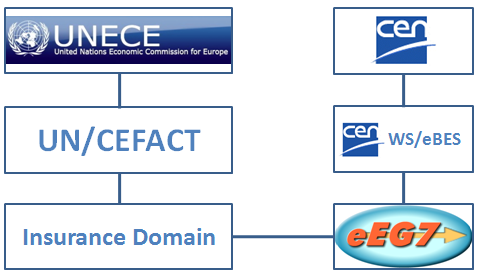
The CEN WS/eBES is a focal point within Europe for the standardisation of exchanging electronic business data. It is the 'European Entry point' for the UN-ECE/CEFACT electronic business standardization process. WS/eBES therefore represents the European point of view in the global debate, including the need for a multi-lingual and multi-cultural approach to B2B data interchange standardisation.
eEG7 is the e-business expert group for the European insurance industry and is a CEN WS/eBES Domain Group. These eBES Domain Groups are European mirrors of the UN/CEFACT Program Development Areas and Domains.
The United Nations Economic Commission for Europe (UNECE) is one of five regional commissions of the United Nations. Its major aim is to promote pan-European economic integration. To do so, it brings together 56 countries located in the European Union, non-EU Western and Eastern Europe, South-East Europe and Commonwealth of Independent States (CIS) and North America. All these countries dialogue and cooperate under the aegis of UNECE on economic and sectoral issues. However, all interested United Nations member States may participate in the work of UNECE. Over 70 international professional organizations and other non-governmental organizations take part in UNECE activities.
Within the United Nations framework of the Economic and Social Council, the United Nations Economic Commission for Europe (UNECE) serves as the focal point for trade facilitation recommendations and electronic business standards, covering both commercial and government business processes that can foster growth in international trade and related services. In this context, the United Nations Centre for Trade Facilitation and Electronic Business (UN/CEFACT) was established, as a subsidiary, intergovernmental body of the UNECE Committee on Trade, mandated to develop a programme of work of global relevance to achieve improved worldwide coordination and cooperation in these areas.
The standards activities within UN/CEFACT are organised in Program Development Areas (PDA) and Business Domains. The Insurance Domain is part of the PDA Sectoral. The main organisations supporting the Insurance Domain are eEG7 and ACORD.

